

Aerobic Septic Control Panels Explained: Timers, Air Switches & Aerator Types
Not all aerobic septic control panels are interchangeable. Two panels may look nearly identical but control different equipment or provide different alarm functions. Before buying a replacement, the three biggest questions are: Does the system need a timer? Does it need an air-pressure switch? And does it use an external air pump or an in-tank shaft-style aerator?
Compare three common aerobic control panels
These real product photographs from Septic Stop illustrate three popular configurations. Open the product links to see specifications and additional photographs. The photos are examples of panel types, not a guarantee of compatibility with your system.
1. NO TIMER
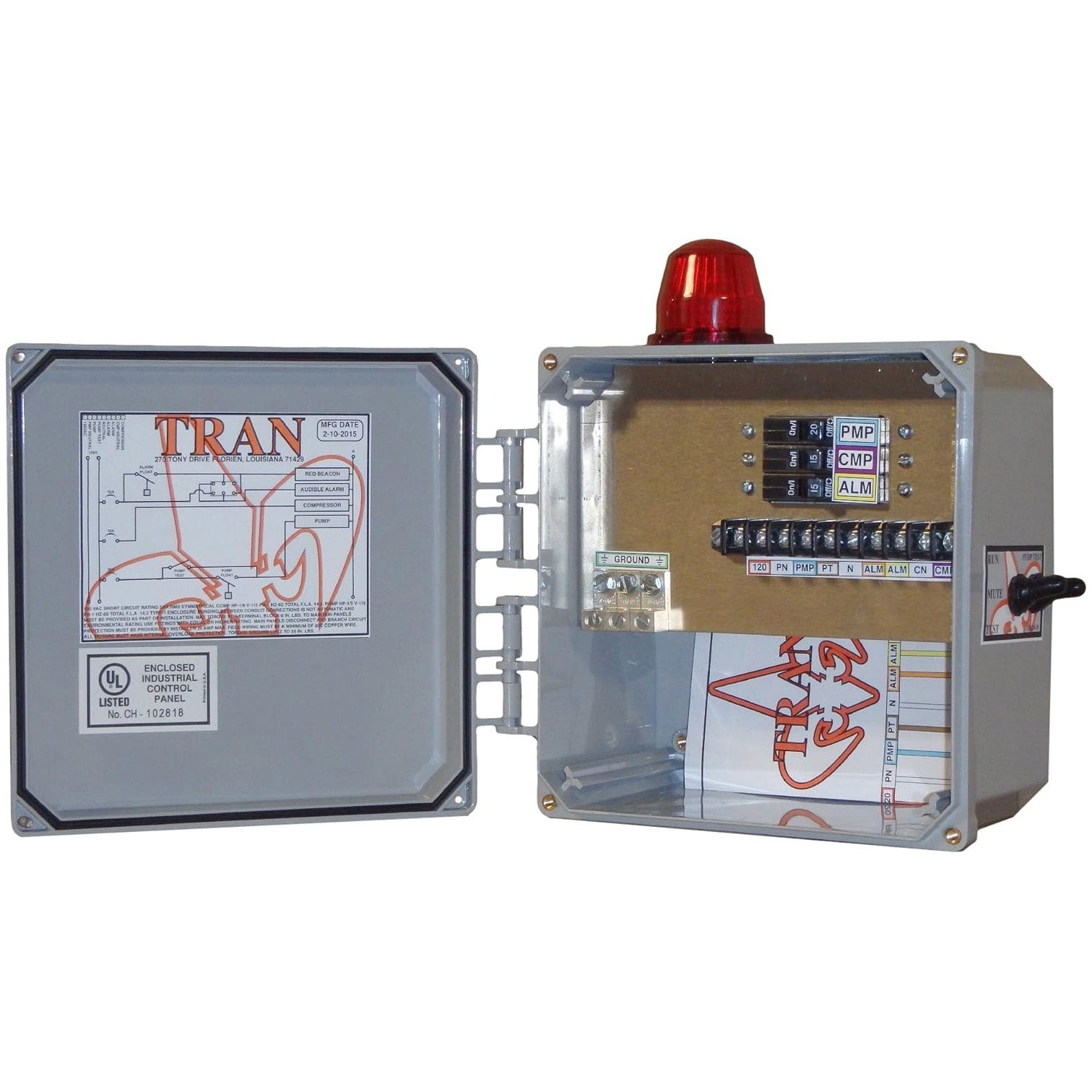
Tran N
Float-controlled demand dosing; no timer or air-pressure switch.

3. TIMER + AIR SWITCH

Tran T2
24-hour dosing timer plus air-pressure monitoring.
Left to right: no timer (Tran N), timer only (SPI 50B120-CPT), and timer with air switch (Tran T2). Images are product photographs from Septic Stop.
1. Timer vs. no timer: how does the effluent pump operate?
No timer: demand dosing
In a demand-dose system, a float switch typically starts the effluent pump when the water reaches its ON level and stops it when the water falls to its OFF level. No dosing timer is needed if this is how the septic system was designed and approved to operate.
Example: Tran N Aerobic Septic Control Panel (no timer).
With a timer: controlled dosing
A timed-dose panel limits pump operation to particular hours or programmed intervals, subject to the float-switch and safety controls. This is common in septic spray systems and in some drip or other engineered dosing applications.
- 24-hour clock timer: Typically sets the hours during which discharge is permitted, such as an approved nighttime spray window.
- Repeat-cycle or drip timer: May control how long a pump runs and rests during a dosing sequence.
- System-specific control: Some panels have additional operating logic beyond an ordinary on/off timer.
Examples: SPI 50B120-CPT Timer-Only Panel or Tran T2 Timer + Air Switch Panel.
2. Air switch vs. no air switch: what's being monitored?
An air-pressure switch (sometimes called an air switch or air sensor) monitors pressure in the air line supplied by an external aerator. If pressure drops below the switch's threshold, the panel can activate an audible and/or visual alarm, helping alert the owner to a faulty air pump, disconnected tubing, or certain air leaks.
A high-water alarm is different: it monitors the liquid level in the pump tank. A panel can have a high-water alarm but no air-pressure switch.
An air-pressure switch is not a direct airflow meter. A restriction or plugged diffuser may leave air pressure high even though the actual airflow is inadequate. Proper maintenance is still necessary.
Not every approved system requires an air switch. Some air pumps have an alarm built in the pump itself. If the original control panel includes air-pressure monitoring, however, the replacement should preserve that required monitoring unless a different configuration is authorized.
Need an air switch but not a timer? See the Tran N2 Control Panel with Air Sensor.
3. Aerator type: external air pump vs. in-tank shaft aerator
External air pumps: linear and rotary types
Many aerobic systems use an external air compressor connected by a PVC pipe (usually 1/2"-3/4") to diffusers in the treatment tank. This category includes both linear diaphragm air pumps (such as Hiblow, FujiMAC and Secoh models) and rotary vane compressors.
Despite differences in how these pumps generate air, linear and rotary air pumps generally use the same style of aerobic control panel. The panel must still have appropriate voltage, circuit/motor ratings, and—if fitted—air-pressure switch settings for the actual compressor and treatment system.
Shaft-style mechanical aerators: Jet and Norweco
Many Jet and Norweco Singulair systems instead use a motor-driven shaft that extends into the treatment tank to aerate wastewater. These are not the same as external air pumps connected to diffuser tubing.
Because shaft-style aerators have different motor-control and failure-monitoring needs, they typically require a dedicated shaft-aerator-compatible panel, rather than a standard external air-pump panel with an air-pressure switch. Some models also have specific aerator run-cycle requirements; do not assume the aerator should run continuously or that a timer in the panel controls the aerator.
Example: SPI RWT-1L Alternative Replacement Panel for Jet and Norweco Singulair. Confirm the exact model and approved configuration before choosing a non-OEM replacement.
Aerobic control panel feature comparison
| Panel feature | What it does | Typical application |
|---|---|---|
| No timer | Pump operates from float demand | Approved demand-dose systems |
| Timer | Limits pump operation to approved times or cycles | Timed spray or drip dosing |
| Air-pressure switch | Alarms for low air-line pressure | Compatible external air pumps |
| External air-pump control | Powers compatible linear or rotary compressors | Hiblow, FujiMAC, Secoh and compatible rotary pumps |
| Shaft-aerator control | Provides controls/monitoring for a motor-driven in-tank aerator | Compatible Jet and Norweco Singulair systems |
Before choosing a replacement panel
Gather these details before ordering:
- System brand and model: Identify the aerobic treatment unit, not just the control box.
- Original panel: Record its manufacturer, model number and required functions.
- Timer: Determine whether the existing panel uses a 24-hour, repeat-cycle or other type of timer, and what it controls.
- Aerator: Identify whether it is an external linear/rotary air pump or an in-tank shaft-style aerator.
- Air alarm: Check for an air-pressure switch, motor-monitoring circuit or another required aerator-failure alarm.
- Electrical specifications: Verify voltage, horsepower, amperage, motor protection and float-switch configuration.
- Approval: Confirm that the proposed replacement is acceptable for the original system design and local jurisdiction.
Take photos of the panel nameplate and the aerator model label if available. Do not open or touch live electrical equipment; have a qualified professional identify internal components.
Before buying or installing an aftermarket control panel, aerator or any other non-OEM replacement part, contact your local regulatory authority (such as your county septic permitting office or health department). Some systems are approved with specific components or control sequences, and replacement with a non-OEM part may need separate approval or installation by an authorized professional. Electrical compatibility does not automatically mean regulatory approval.
Read the Septic Stop Installation & Regulatory Compliance Policy.
Shop replacement aerobic septic control panels
- Tran N — No Timer / No Air Switch
- Tran N2 — No Timer / With Air Sensor
- SPI 50B120-CPT — Timer / No Air Switch
- Tran T2 — Timer / Air Switch
- Tran T2 Drip — Drip Timer / Air Switch
- SPI RWT-1L — Jet / Norweco Shaft-Aerator Alternative Panel
Or browse all aerobic septic control panels.
Frequently asked questions
Can I replace a timer panel with a no-timer panel?
Only if the replacement preserves the approved operating requirements and the change is authorized. A required dosing timer should not be eliminated.
Does a panel with a high-water alarm also have an air switch?
Not necessarily. High-water monitoring and air-pressure monitoring are separate functions. Check the panel specifications.
Do linear and rotary air pumps require different control panels?
Not usually a different style of panel. Both are external compressors that may be operated by the same general panel design, but electrical ratings, motor-starting requirements and air-pressure settings must be suitable for the exact compressor.
Can I use a standard external air-pump panel on a Jet or Norweco system?
Generally not as a direct replacement for a shaft-style aerator panel. Jet and many Norweco Singulair systems require dedicated motor controls and aerator-failure monitoring.
Is an aftermarket replacement panel always allowed?
No. Confirm approval requirements with your local regulatory authority before purchase and installation, particularly when substituting a non-OEM component.
Need help choosing the right panel?
Send Septic Stop a photo of your current control panel and the aerator's model information. We can help compare the available panel features and specifications. Your installer, system manufacturer and local regulatory authority should verify final suitability and approval.
Contact Septic Stop Shop Control Panels
This article is for general product education. Follow manufacturer instructions, the approved septic-system design, applicable electrical requirements and local regulations. Installation or electrical servicing may require a licensed or authorized professional.

